HDD vs SSD: Which is the best choice for your computer?
If you want to speed up a sluggish PC, you have likely heard the terms HDD and SSD. But what is the actual difference between these two types of storage, and why does it matter for your home computer? Understanding the HDD vs SSD debate is the primary step toward owning a faster, more reliable machine.
What is a traditional HDD?
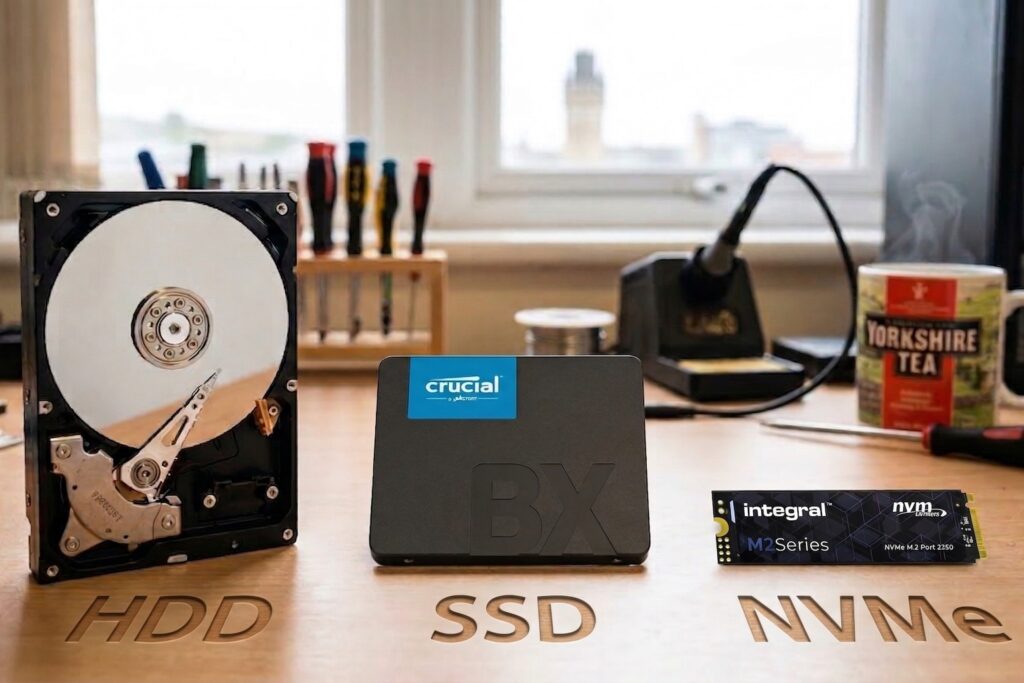
A Hard Disk Drive (HDD) represents the “traditional” way computers store data. Inside the casing, you will find a rapidly spinning magnetic platter and a small mechanical arm that reads and writes information – much like a high-tech version of a vintage record player.
-
The Pros: They generally offer cheaper storage if you need a massive amount of space (several terabytes) for large video collections or system backups.
-
The Cons: Because they rely on moving parts, they are slower, noisier, and prone to physical failure. In fact, if you suspect your current hard disk is struggling, you should read my guide on the five signs your hard drive is failing before you lose any data.
What is a modern SSD?
A Solid State Drive (SSD) uses flash memory – the same technology found in USB thumb drives and smartphones. Crucially, a solid state drive contains no moving parts at all. When comparing HDDs and SSDs, this lack of movement is the “secret sauce” that makes your computer feel instantaneous.
-
The Pros: They are incredibly fast. An SSD upgrade allows your computer to boot up in seconds. They are also silent, run cooler, and handle the knocks and bumps of daily life much better than old-fashioned mechanical drives.
-
The Cons: While prices have dropped, they remain slightly more expensive per gigabyte than traditional disks. However, most users find the HDD vs SSD price difference well worth it for the performance boost.
Taking it further: SATA SSD vs NVMe
Not all solid state storage is the same. When I upgrade a customer’s PC, I usually choose between two types of SSD technology depending on the age of their machine:
-
SATA SSD: These are roughly the size of a pack of playing cards and fit into the same slot as an old hard drive. They provide a massive speed increase over any HDD.
-
NVMe (M.2) SSD: These look like a small stick of chewing gum. They plug directly into the computer’s motherboard and are up to five times faster than a standard SATA SSD. If your computer supports NVMe, it represents the absolute gold standard for performance in 2026.
Why the HDD vs SSD choice matters for you
For the average home user in the UK, the speed difference is the most noticeable factor. When you move from HDD to SSD technology, Windows feels “snappy” again. Your web browser opens the moment you click it, and you won’t have to wait for your holiday photos to load one by one.
Furthermore, because a solid state drive lacks a mechanical arm, it doesn’t suffer from the “clicking” failures common in old hard drives. This SSD upgrade effectively removes the most fragile part of your computer, making your data much safer in the long run.
Can you upgrade an old computer?
Many of my clients believe they need a brand-new laptop when their current one becomes slow. In reality, I can often remove your old, struggling HDD and replace it with a modern, high-capacity SSD. When deciding between HDD and SSD, the upgrade is almost always the better financial choice. I move all your files and Windows settings across so that everything looks exactly the same – only much faster. It is a brilliant way to save money while enjoying a “new computer” experience.
Need a speed boost?
If your computer feels like it’s stuck in low gear, an SSD upgrade could be the answer you’re looking for. I specialise in helping local residents breathe new life into their existing equipment. If you live in my service area, I can handle the entire SSD installation process for you. I ensure your precious photos and documents stay safe during the transition from your old HDD. Contact me today for a friendly chat about how we can make your PC fast again.